


- This event has passed.
Horme Therapy
December 6, 2025 @ 10:00 AM - 4:00 PM
RSVP
Price: $ 150 + tax
Tickets for attending Event: Horme Therapy
- Introduction to Tibetan Medicine
- Introduction to Three Body Types
- What is Horme
- When to apply Horme
- Tools needed for Horme
- Philosophy of Horme
- Body points for Horme
- Horme therapy for self-care
- Horme therapy for others
There is no requirement to be familiar with the Traditional Tibetan System of medicine.
Hormé is deeply relaxing, warming, and nourishing therapy. Horme uses customized herbs depending on the type of ailment and wrapping them in cotton. These are then dipped in warm oil and applied to points on the body. This is a very effective technique for stress reduction. Sowa Rigpa’s most famous hot compress therapy, hormé, has its roots in ancient Tibet, when nomads would dip homemade felt in hot oil and apply it to particular points of the body as a soothing, warming therapy. The Tibetan tradition uses a unique system of meridians and energy centres rooted in tantric Buddhist physiology. This is an excellent class for anyone interested in applying this simple home remedy for self-care, or naturo-therapists and massage therapists.
According to etymology, the term Hor-me comes from upper Tibetan nomads. Hor refers to the people of North Tibet. Ancient Tibetan history shows that there were three main ethnic groups of inhabitants: white, yellow, and black Hor people. Me’ means fire or heat produced by fire used in this particular practice. Hor-me is then a healing practice technique of these northern regions of Tibet.
According to Tibetan Medicine Sowa Rigpa, the best plants to address the winter’s cold winds originate on the West side of the Medicine Buddha Pure Land:
1) nutmeg to strengthen and stabilize the link between the heart and mind;
2) cloves to strengthen the life channel and address intestinal cold wind;
3) black and green cardamom to address stomach and kidneys cold winds.
Medicine Buddha Pure Land description:
South: pomegranate, black pepper, long pepper, capsicum, asafoetida, sumac, cinnamon, cassia or ginger, pine tree-trunk, clematis, rhododendron, buttercup, civamcivaka, buttercup, and bonducella fruit.
West: nutmeg, cloves, bamboo pith, saffron, cardamom, cubeb / greater cardamom.
North: white sandalwood, camphor, eaglewood / aloeswood, chinaberry, gentian, licorice, coleus leaves, white aconite, red sandalwood, birthwort, spleenwort, kapok stamen, calyx, and corolla, and grape.
East: myrobalan.
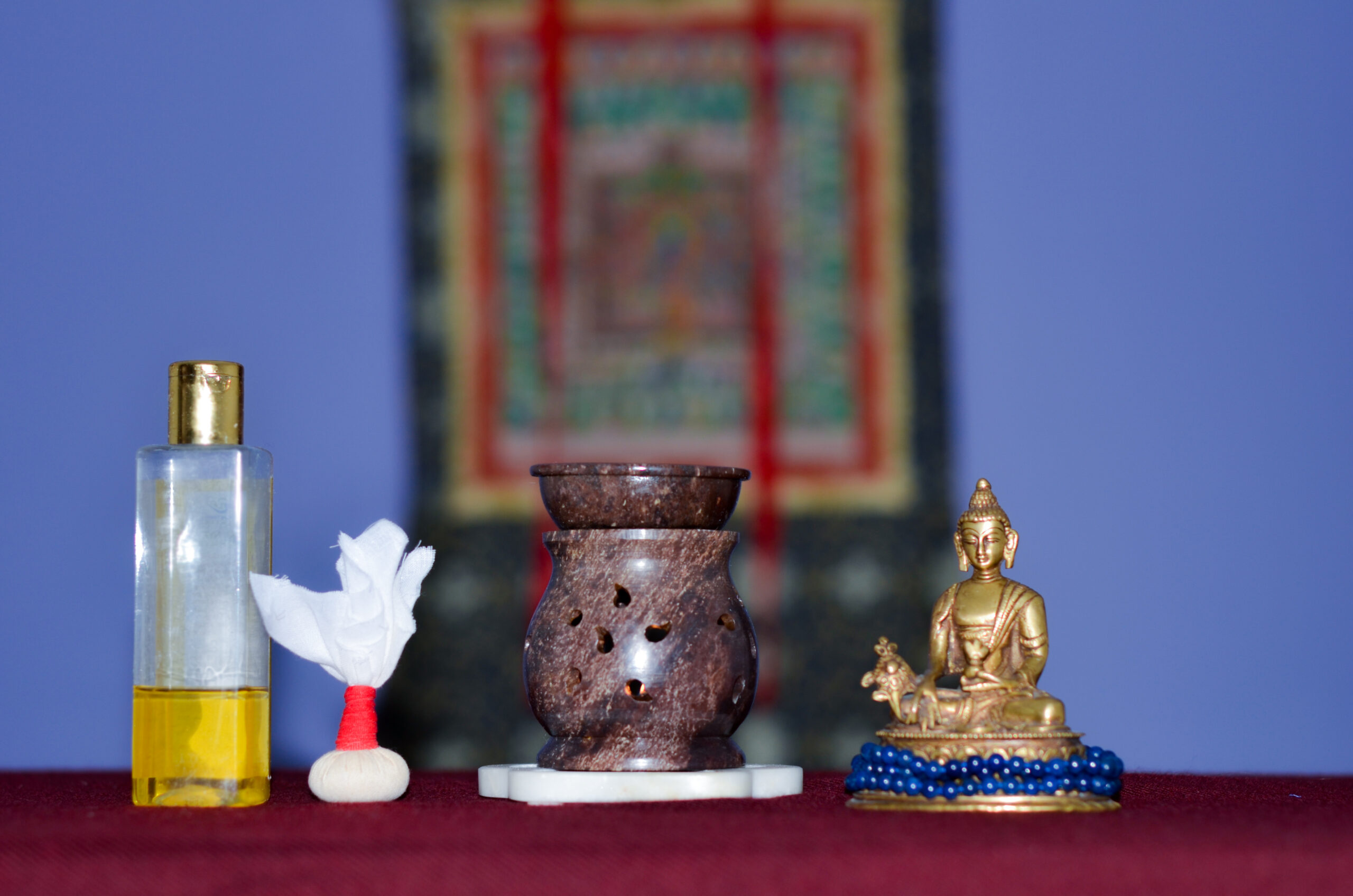
Although it’s not necessary, having this for the class would be useful:
1) A hand-size oil heater (stone or ceramic),
2) Candles,
2) Sesame oil (organic if possible),
3) 16 cm by 16 cm cotton-wrapped herbal pouches with two tea spoons of herbal powder: 50% ground nutmeg, 25% ground cardamom, 25% ground clove, knotted at the top with a crimson thread for protection and good fortune;
4) A statue, thangka, or image of the Medicine Buddha or Yuthok.
To construct herbal pouches, prepare the cotton cloth, cut 14-cm-diameter cotton circles, insert the ground nutmeg, clove, and cardamom mixture in the center of the circle, wrap it in the cotton circle, and tightly tie it with cotton thread, leaving some cotton on top for a handle.
Medicine Buddha Mantra:
TEYATA OM BEKANZE BEKANZE MAHA BEKANZE BEKANZE RADZA SAMU GATE SOHA
Yuthok Mantra:
OM A HUNG BAZA GURU GUNA SIDDHI HUNG
Horme therapy shouldn’t be used for fire element excess, which includes high blood pressure, severe inflammation, high temperature, and hot bile disorders like jaundice.
Teacher: GM Brana
The Manual and the certificate are included. In person and online.
If you attended Horme For Self-Care, you get a $50 discount.
If you attended Horme for Professionals, you get a $100 discount.
About Sowa Rigpa
Tibetan Medicine- Sowa Rigpa, is the traditional medical system of Tibet and the Himalayas. It’s one of the oldest healing traditions in existence, yet it remains fully alive today. Sowa Rigpa integrated elements from the medical systems of ancient Tibet, India, Greece, Mongolia, Persia, and China, forming a unique medical tradition with a distinct Himalayan character shaped by both pre-Buddhist and Buddhist thought.
In Buddhist philosophy, the ultimate underlying causes of both physical and mental diseases are said to be the three mind poisons: ignorance, desire-attachment, and anger. The basic cause of illnesses according to Buddhist philosophy, is the ego, full of trivial pursuits and clinging attachments. It is this clinging nature that ultimately produces the confused mind and thereby all suffering and disease.
The Tibetan word Sowa can be translated as healing or nurturing, while the word Rigpa means both science and awareness. Thus Sowa Rigpa (or Sorig) can be understood as both, 1) the healing science- a system of medical knowledge and practice that brings relative balance and health of body, energy, and mind and 2) nurturing the awareness- a tool to understand the nature of your mind and the universe and accomplish absolute balance and liberation.
The essence of the traditional theory and practice is contained within the Four Medical Tantras considered the root text of Tibetan Medicine:
Root Tantra: an essential map of the medical system, including the basis of health and disease.
Explanatory Tantra: an exposition of anatomy, physiology, and embryology, as well as diagnosis and treatment.
Oral Transmission Tantra: a detailed presentation of diseases from eight major branches of pathology, with treatments.
Final Tantra: instruction in practical and clinical medicine.
The Four Medical Tantras were composed by Yuthok Yonten Gonpo the Elder (729-854 AD) and revised by Yuthok Yonten Gonpo the Younger (1126-1202 AD).
In Tibetan medical texts, 404 diseases are mentioned:
101 are karmic diseases, which are fatal without Dharma teacher and sincere student, and they cannot be cured by medical treatment;
101 are diseases caused in this lifetime and need medical treatment with herbs, massages, surgery or other natural therapies;
101 are caused by spirits, and need spiritual treatment, such as spiritual ceremonies; and
101 are caused by inadequate diet and behavior and can be remedied without medicine, by changing food habits and lifestyle.
Conditions that have a karmic root-cause, without a qualified spiritual guide, a teacher of Dharma, and a good relationship with the spiritual guide, are considered in Tibetan medicine- incurable.
“The master is the source of all knowledge and higher experiences that one can acquire within a short period of time if the master is pleased by their genuine sincerity.” Tibetan medical text
Generally, teachers of Dharma of Tibetan medicine, should not be teaching students who have the following three negative mindsets and intentions:
- A student who is like a poisonous contaminated container;
- A student who is like a closed container;
- A student who is like a container with a hole at the bottom.
A contaminated container refers to negative motivations to learn the art of medicine, such as wishing to become rich, famous, to harm others, or to produce mass destruction. A closed container represents the lack of interest in the studies. It can be the case when someone is forced to learn by the family or situation. It is then useless to learn the art of awakening or healing. A container with a hole at the bottom means there is interest and facility to learn, but also a lack of the faculty to memorize. The student is then not able to study the art of awakening and healing, he cannot help others.
According to Buddhist philosophy, everything is made up of five elements: space, air, fire, water, and earth. These five elements can be combined into three dynamic principles rLung- the wind element (neutral energy), Tripa- fire element (hot energy) and Beken- water and earth elements (cold energy).
 Click the icon to read the article.
Susannah Deane in her article “rLung, Mind, and Mental Health: The Notion of “Wind” in Tibetan Conceptions of Mind and Mental Illness” described the rLung conditions, based on the wind type, according to Sowa Rigpa. RLung is understood to be intimately connected to the mind, and we hear the expression that “the mind rides the wind like a man rides a horse”.
1- Ascending Wind: Localised in the chest, it circulates in the region of the throat, nose, and tongue. Connected to the element of fire. Symptoms of disruption may include stammering or difficulty speaking, loss of physical strength, facial paralysis, and memory loss.
2- Pervasive Wind: Localised in the region of the heart, it pervades the whole body. Connected to the element of space. Symptoms of disruption may include discomfort in the heart, unconsciousness or fainting, meaningless talking, and restlessness, decreased mental functioning, unsubstantiated fears, and panic attacks.
3-Metabolic Wind: Localised around the navel and stomach. Connected to the element of air. Symptoms of disruption may include poor digestion and/or a loss of appetite or vomiting.
4- Descending Wind: Localized in the colon, bladder, and reproductive organs. Connected to the element of earth. Symptoms of disruption may include aching in the hips, constipation, and gas accumulation in the stomach, as well as restlessness and fear, psychological and emotional distress, such as jealousy, fear, and worry.
5-Life-sustaining Wind: Localized in the heart or at the crown of the head. Connected to the element of water. It is understood to support the life force and hold the consciousness. Symptoms of disruption may include confusion, auditory and/or visual hallucinations, restlessness, stress, anxiety, depression, dizziness, and insanity—as well as physical symptoms such as difficulty in drawing breath or swallowing food or drinks, reduced appetite, fatigue, and headache.
[academia_icon_box layout_style=”style5″ icon_type=”fontawesome” icon_fontawesome=”fas fa-globe” icon_color=”#8c1115″ link=”url:%20https%3A%2F%2Fus04web.zoom.us%2Fj%2F9074655172%3Fpwd%3DMbT2GhE8xIhDeaqfSPdoKObZNGZR10.1|title:How%20to%20join%20this%20event%20online”]
How to join this event online?
- On this event page, click on RSVP to reserve your place.
- Make sure that you are connected to the Internet and open a web browser.
- Click on: https://us04web.zoom.us/j/9074655172?pwd=MbT2GhE8xIhDeaqfSPdoKObZNGZR10.1
- Click on the Open Zoom Meetings button.
- When you log in please mute your speaker.
- You are welcome to enable your camera.
- There is a chat button for questions.